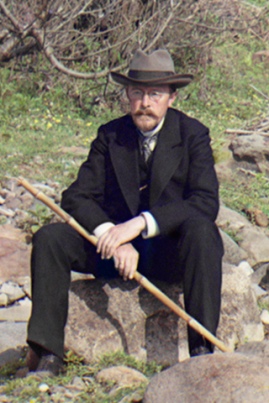
The Photographer
Sergei Mikhailovich Prokudin-Gorskii, photographer and chemist in the early 1900s, displayed the powerful Russian Empire pre-World War I and revolution with the use of colored photography, a new technique that he developed during the time. Supported by Tsar Nicholas II and with the aide of the Ministry of Transportation, Prokudin-Gorskii traveled in an equipped railroad car (that even included a darkroom), to photograph eleven regions including regions such as present day Poland and Finland. Although his subjects were diverse, such as railroads and medieval churches, his photographs of the ethnic diversity that remained intact despite Russian acquisition is a fascinating insight to the times.
Culture Remains Intact
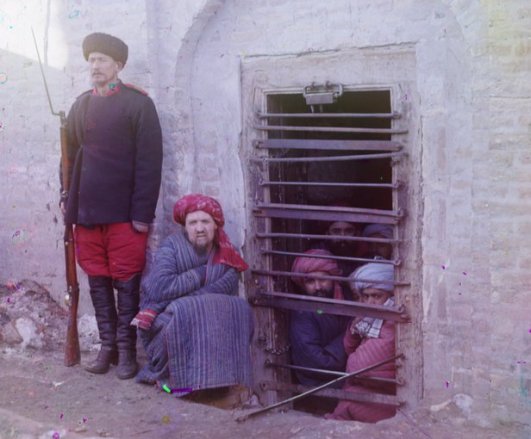
1907- Prokudin-Gorskii photographed a Zindan, or prison, in Bukhara, then called Turkestan, and nowadays located in Uzbekistan. Five inmates peer out through the prison bars, accompanied by a visitor squatting outside. The Russian uniform of the prison guard greatly contrasts with the robes of the locals, displaying the traditional clothing of Bukhara. This photograph is a prime example of the predated forced “Russification” that had yet occurred in the Russian empire.
A Closer Look…

Zindan today is referred to as Emir’s Prison- one of two prisons in Bukhara. The prison was made up of a multiple debt chambers, a solitary confinement cell, and an underground dungeon that was dug about 21 feet deep into the ground. Prisoners mainly included debtors or those who did not carry out their “citizen’s duty” in following religious instructions and authority, as religion had the highest authority in Bukhara at the time (another show of how culture was retained). The imprisonment was extreme and death for the prisoners was expected. The prison was also referred to as “Bithana”, or the “bug pit” due to the plethora of scorpions and other poisonous insects that found their way into the cells. Due to the treacherous bites, prisoners often died within two to three days of imprisonment.
Sources:
https://www.loc.gov/exhibits/empire/
https://www.loc.gov/exhibits/empire/ethnic.html
https://www.wdl.org/en/item/6533/
https://orexca.com/monuments_bukhara_zindan.shtml
http://www.visituzbekistan.travel/sightseeing/bukhara/zindan-dungeon/


