By the middle of the 19th century the Russian Empire found itself lacking in reform and by the start of the 20th century it found itself in a questionable circumstance. Imperial Russia was late to the game in the industrialized arena, but it did attempt to westernize itself. In the process, the introduction of new transportation systems such as the railroad helped connect the primarily agricultural society. The image below stood out to me because it was one of the few pictures that introduced elements of industrialization sought in Russia at the time.
Through scientific discovery Sergei Mikhailovich Prokudin-Gorskii discovered a way to to photograph images with color presentation. Becoming a well renowned artist, Tsar Nicholas II invited him to display his work for the imperial family. An impressed Nicholas would go on to finance a 10 year expedition in which Prokudin-Gorskii would photograph Russia in color, below is one of those images.
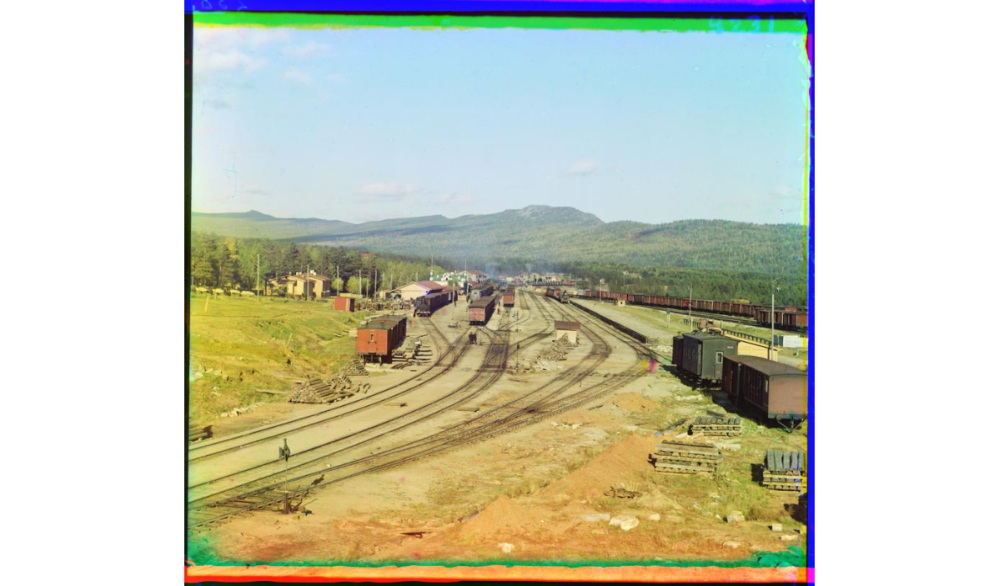
“Zlatoust Station” Sergei Mikhailovich Prokudin-Gorskii (1863–1944)
This image was what the town of Zlatoust looked like in September 1909. Founded in 1754, the town was known for its fishing and metalwork capabilities. Located in present day Chelyabinsk Oblast, the town was photographed while Prokudin-Gorskii was exploring the railroads, industries, and natural scenes of the Ural Mountains. The town started to see an increase in manufacturing when a railroad line from Samara was completed in 1890, as well as the beginning of the Trans-Siberian Railway project in 1891.
In the picture you can clearly see many trains busy at work, but not to the extent of images seen in America and Europe at the time. Russia was faced with crippling economic issues as the concept of serfdom was coming to an end. To put the railway pictured above into perspective, during the American Civil War, images of vastly connected railways were photographed with advanced networks of commercial and industrial rail lines. At almost 50 years after the American Civil War, the Russian Empire still stood far behind the West when it came to industrial matters, making the reforms of Tsar Alexander II, Alexander III, and Nicholas II that much more important to the survival of the Russian Empire….
If you would like to watch the blog post in a cinematic manner, I made a video version:
Sources
https://www.wdl.org/en/item/5281/#q=Prokudin-Gorskii
http://www.loc.gov/exhibits/empire/index.html
https://www.transsiberianexpress.net/trans-siberian-railway-history.html


