Earlier this semester, we spent a lot of time talking about the displaced persons created in the wake of World War II. They were often unable to physically return to their homes, and lost their cultures and communities to the destruction caused. In Lila Abu-Lughod’s article Return to Half Ruins, she talks about how many of the Arabs who had been living in Palestine before the foundation of Israel were put in a similar situation as the aforementioned displaced persons across Europe.
In the article, Abu-Lughod argues that these Palestinians were “dislodged socially and politically but in place physically” (p. 77) and that they were sort of forced to assimilate the best they could, with no opportunity to maintain their home the way it had been for so long before the Zionists took it from them. These people are similar to displaced persons in that while they perhaps were able to still live where they had been, their home had been radically changed and they weren’t even the primary group of people their homeland was meant for anymore. They either had to deal with and adapt to the new powers of their land or get out. This ended up causing the 1948 mass exodus of Palestinians, where over 700,000 Palestinians fled or were expelled from their own home. The word “Awda”, meaning “return” became very important and emotionally charged after this event for Palestinians, as it symbolizes their desire to return to and reclaim their homeland from the Israelis.
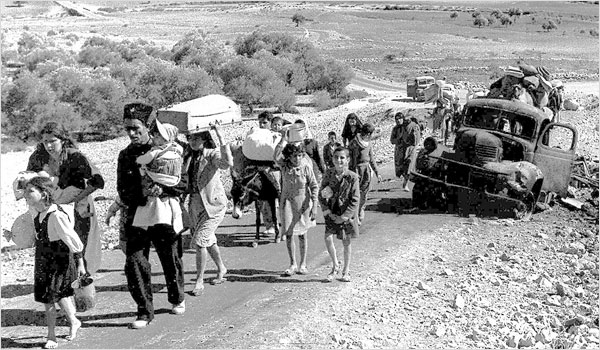
Adu-Lughod recounts various stories told by her father, who was a young child when the Zionists started taking control of Palestine. her father seemed to feel a strong connection to his homeland, as evidenced by a quote from her father after he had gone back to his home (now Israel) for the first time: “Most people I had spoken with [who returned] felt sadness or loss. I felt quite the opposite. I was happy to be reconnected with my land, to know that despite the changes, much of Palestinian culture survived Israel’s assault. It did so through the powerful efforts of those who remained on the land”. This shows us that while surely Palestine was devastated by the Israeli occupation and forced exodus of many of its people, the Palestinian people’s culture would not be as easily removed. It makes me happy to learn that these people are still proud of their heritage, culture, and traditions, and especially that their culture still lives on even in the very land they were ejected from.
Overall, this article evokes a heavy feeling of sympathy for the Palestinians, and, at least for me, made me feel much more invested in what has happened between them and Israel. This was likely achieved through the use of so many personal accounts from the authors father, who has lived through this whole conflict, and made it at feel a little more real. I now better understand how powerful firsthand accounts can be when trying to persuade people, and have been pretty effectively convinced that a grave injustice has been levied upon the Palestinian people. I of course will not pretend to understand all the nuance and issues involved in this conflict, as the Israelis of course also have their side of the story, but Adu-Lughod’s writing and personal examples almost made me question that fact.


I completely agree that firsthand accounts are powerful when trying to persuade people. When it is merely an objective article it is hard (at least for me) to sympathize with the individual people involved. When there is a story about one person’s experiences that is when it becomes more real for me.
I liked your quote about how Palestinians were forced to assimilate even is they were able to maintain their homes their homeland was no longer their. Their identity was shaken and forced to adapt. This idea of the shaping of identity for displaced persons ties back to other weeks. I like that you acknowledged the impact that these sources had on you. I think that this is a key aspect of the value of these sources.
I’m intrigued by your statement about the Palestinians were not the primary group of people living in their homeland. In ancient history that area, known as the Levant, was home to dozens of people, most notably the Jews. I agree that it is the homeland of the Palestinians, but I’m just putting it out there that an area can be the homeland to more than one group of people.