Displaced Persons were quite the commodity to be had after World War 2, depending on the person. The Western powers that had successfully freed Europe from the grip of the Nazis were quite welcoming to many of the displaced millions, but only if they were of use to them. In Gerard Cohen’s book In Wars Wake, he looks at the treatment and use of displaced persons (DP). In chapter 5, Surplus Manpower, Surplus Population, Cohen looks at how these displaced persons were enticed to come to the Western countries of Europe, notably France, Belgium and Great Britain. These countries had a particular interest in displaced persons due to their labor potential. They had begun programs to bring in this displaced population that had no home to go to and use them to rebuild their own countries. In France, preference towards Italian workers that would replenish their labor industry and help rebuild what had been destroyed. These countries were very selective of their chosen laborers, focusing on those who were young, single and ready to work. Met with varying success, these DP were often treated as paid slave labor, taking the hardest manual labor jobs that nobody else would do. At least that is the way it looks to me, a form of slave labor. These laborers were being used as political tools to advance these countries with little to no benefit of the laborer, with them often being paid far too little or even wishing to return to their home nation. The United States helped move the political aspect of this along by threatening to recall any Marshall Plan support given to countries who did not open their nation to the displaced persons (Cohen pg. 106).
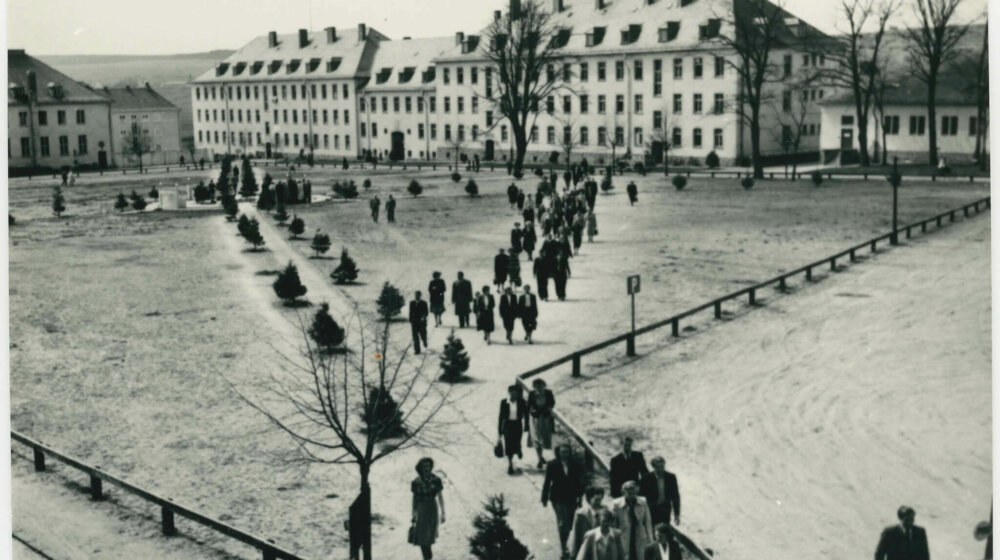
A displaced persons camp in Arolsen, Germany.
In “Dark Strangers” by Chris Waters, the opening of the book raises a particular issue that I’ve noticed quite often recently. He goes over the problem that Great Britain faced after WW2, what did it mean to be British? That question had been easy enough to answer in the past, someone of Anglo-Saxon decent with white skin. With the increase in immigration, that began to unravel as more and more immigrants came to Britain from all over the world. Waters includes a snippet from Linda Colley about the relationship between national identity and national boundaries. Are national identities solely identified by where the person is from on the map? I believe that national identities are becoming a thing of the past. With everyone being so different today, with so many opinions and different thoughts, it is getting rather difficult to effectively group them all together to say they’re the same. This is becoming increasingly prevalent in the United States. Because the United States is a nation of the free, almost anyone from the world can emigrate and live in the United States. The similar question of what is an American then comes up. Is an American simply someone who lives in the U.S. and is classified as a citizen? If that is the case then someone who doesn’t speak a word of English with no prior knowledge of any U.S. history can be an American. I’m not looking at this in a negative manor, simply putting my opinion that national identities are becoming less prevalent because they can be so broad in terms of use.
Picture: https://arolsen-archives.org/en/news/neue-publikation-displaced-persons-in-arolsen-nach-1945/


I find your argument that national identities are becoming less prevalent to be very interesting. I’m not sure that I would argue that the broadening of terms necessarily means that national identities are declining. However, I’m also not saying that you are wrong. It seems to be that identity is simply becoming different. In a sense, it is true that national identity is declining in exchanging for different identity groups. However, I would say that this is becoming a reality, not because terms are broadening, but because they are becoming more closed. For example, in the United States, national identity is falling to regional identity. Thus, the idea of “American” is changing to need to incorporate even more specific terms, like “Western,” “Northern,” “Southern,” “Urban,” “Rural,” etc.
I agree with Clay. National identity is becoming more regional. While everyone is united by their country their identity is strongly influenced by where they live.
It is interesting that these countries saw these displaced people as nothing more than labor, it makes me wonder about the countries’ true intentions behind their forms of reconstruction. I do think that national identity is changing because of the people that these national identities belong to.
I think that you make good points and emphasize the important aspects from the authors, particularly your assessment of Cohen and the argument he is making regarding the DPs. This ability that you demonstrated to analyze the perspective and main ideas of the author is important when considering the historiography of this topic.