As established, Displaced Persons were a major political object during the Postwar era. Not all DPs returned to their native country– many stayed in whatever country they found themselves in for an extended time, whether that be the U.K., France, Germany, or elsewhere. Some did not want to return to their native country, some had nothing to their name and decided they might as well make a go of it with a new start. The United States and Great Britain, as the two most influential powers in western Europe in the immediate aftermath of WWII, paired up two facts: 1) Europe was in desperate need of reconstruction, and 2) DPs were abundant in western Europe. The logical conclusion was to give the DPs newfound purpose by putting them to work in their present country with the simultaneous intention of assimilating them into that same country’s culture to some extent.
Hence, the abundance of DPs no longer had to be viewed as a burden or humanitarian crisis to nations. Rather, DPs could be sifted through and evaluated with work placement programs to turn them into useful labor for the nation they found themselves in. Sometimes, there was still an excess of DPs even after selections were made for laborers. Artists, scholars, and other professionals who were not deemed necessary to reconstruction were often redistributed abroad to mostly English speaking countries. Professor of History Gerard Cohen of Rice University analyzes the transformation of this issue in his 2011 book In War’s Wake: European Refugees in the Postwar Order. Cohen encourages the perspective that the DP problem was perhaps never a crisis of humanity to Europe’s governments, but was a simple matter of finding a way to put the DPs to optimal use for the countries hosting them. Essentially, this argument contrasts with the perspective that the DP crisis was a matter of ensuring people their human right to belong to a nation. This perspective makes the governments seem more dispassionate, but if DPs were relocated to a new country or welcomed as laborers in their current country, they had, in essence, been granted their right to be included in a nation nonetheless.
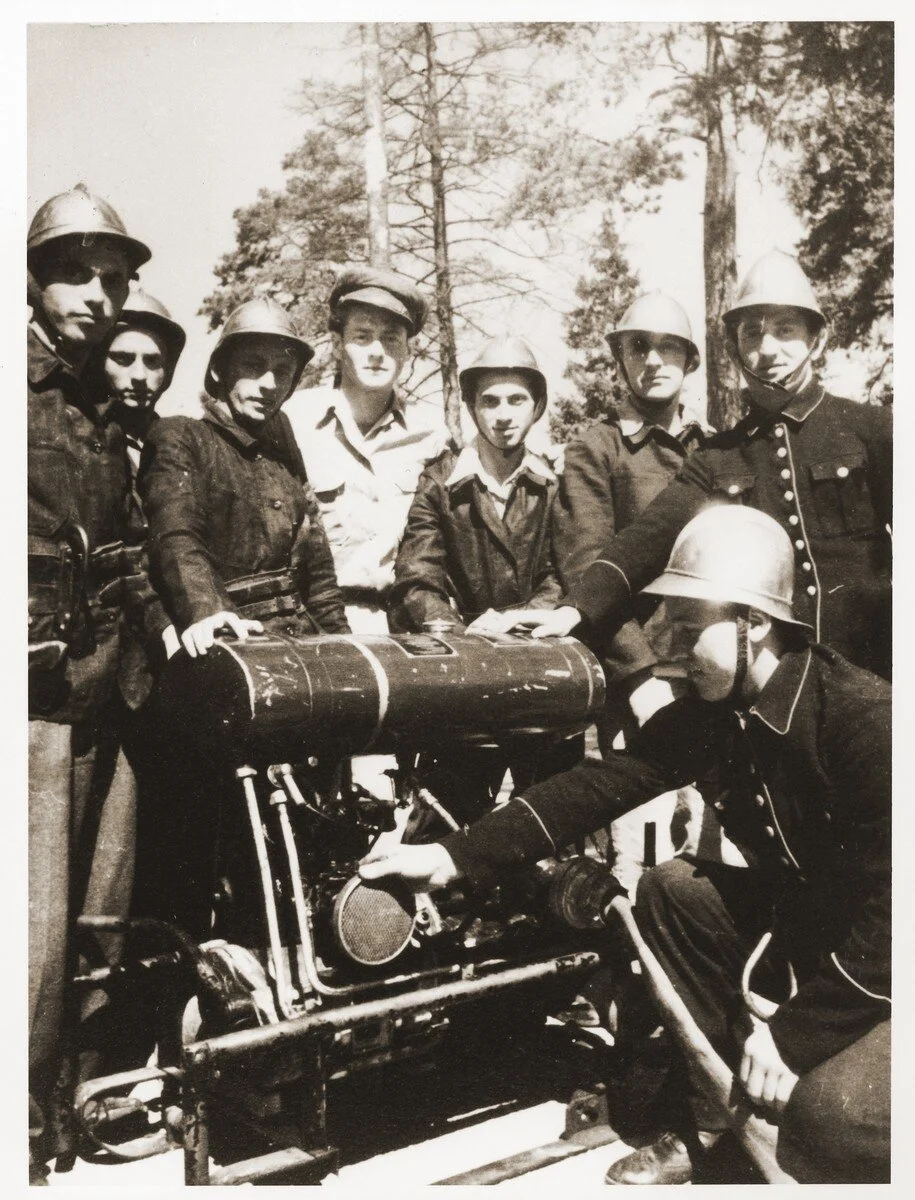
Foehrenwald Jewish Fire Brigade (George Oscar Lee, in white uniform)
Holocaust survivor George Oscar Lee found himself in Foehrenwald Displaced Persons Camp southwest of Munich in what was then U.S.-occupied Wolfratshausen, Germany. Foehrenwald started out as housing for a German chemical company, but was converted into a DP camp by the UNRRA in 1945. It became a specifically Jewish DP camp after U.S. General Eisenhower visited the region and determined the camp was too crowded, and therefore Jewish people were chosen to stay while other groups were relocated. Foehrenwald was one of the largest DP camps, to the point where it actually grew into more of a town with a peak population of over 5,000 in 1946 (United States Holocaust Memorial Museum). As a town, Foehrenwald needed infrastructure and public services, and Lee founded both the local fire department, which he was the chief of, and police department. Simultaneously, Lee provided the community with necessary services and created jobs for the camp’s inhabitants. Foehrenwald remained open until 1957, by which point all of its inhabitants had emigrated (usually to Israel or the United States) or rejoined German society. In this example, we can see both outcomes to the DP problem: people relocated to foreign countries or they stayed as misfits until they assimilated.
This YouTube video can tell you more about Foehrenwald DP Camp and George Oscar Lee’s story: https://www.youtube.com/watch?v=8zkfMWe1PjU.
However, not all DPs had such a generous window of time to assimilate into the societies they found themselves in. In Great Britain, a country whose national identity was so centered around surviving WWII that when the war ended they had a damaged national fabric left, DPs were quickly isolated. So argues historian Chris Waters in his paper “Dark Strangers’ in Our Midst: Discourses of Race and Nation in Britain, 1947-1963.” In this case, DPs were accepted for their ability to contribute to the British workforce, but as native Brits sought to rebuild an identity for themselves, DPs stood out at distinctly non-British people.
In each of these contexts, we can follow this theme: the decision to view DPs as an economic problem instead of a humanitarian one, for better or for worse, allowed nations to more easily craft their solution to the problem.
Bibliography
Cohen, Gerard. In War’s Wake – Europe’s Displaced Persons in the Postwar Order (2011).
United States Holocaust Memorial Museum. “Foehrenwald Displaced Persons Camp.” Holocaust Encyclopedia. United States Holocaust Memorial Museum, 2021. https://encyclopedia.ushmm.org/content/en/article/foehrenwald-displaced-persons-camp.
Waters, Chris. “‘Dark Strangers’ in Our Midst: Discourses of Race and Nation in Britain, 1947-1963.” Journal of British Studies 36, no. 2 (1997).


Your analysis that the utilitarian aspect of the DP problem being a means of accomplishing things is very interesting. It is an important reality for us. While people may not have been as humanitarian as possible, it still created a humanitarian reality. People may not have had the best motives or created the best results, they did create an opportunity for people to have access to something better than they had before.
The DP problem was unfortunately seen as an opportunity for economic gain. Countries wanted laborers that would help them rebuild and make them economically successful. They cared more about what DP’s could do for them, than what they could do for the DP’s.
Wow- great post- you really tied in the readings with the example of Foehrenwald Displaced Persons Camp (the link made it).
In the post-war reconstruction era, there was an immediate want for economic reconstruction above all else. It makes me wonder if there was a humanitarian focus rather than economic, where would Europe be today in regards to human rights.
I really enjoyed your use of the story of George Lee, and think it added significant amount to the perspective of your post. The manner in which you not only took the assigned class readings, but also went above and beyond with your own individual research I thought was excellent, good job.