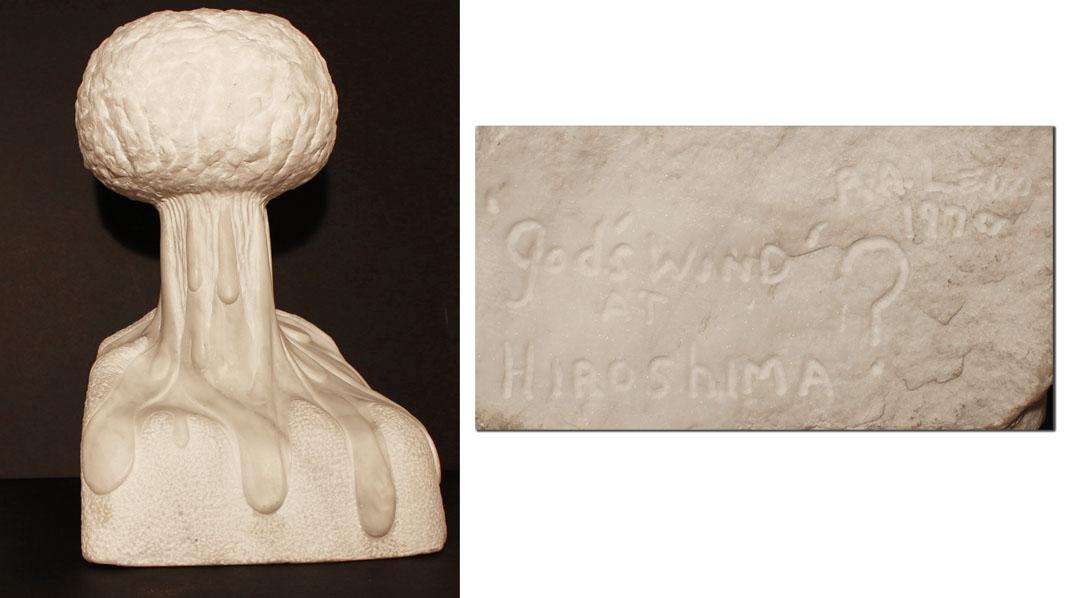
The dropping of the atomic bomb on the cities of Hiroshima and Nagasaki proved to be incredibly devastating. It led to disfigurement, trauma, and long-term illnesses. Historian David Serlin, in his writing about the Hiroshima Maidens, referenced the image pictured above to discuss the psychological repercussions that plagued the man who was in the plane that dropped the bomb on the city of Hiroshima. Serlin, however, in his writing focuses primarily on the disfigurement faced by a number of women living in Hiroshima at the time of the bombing. Another historian, Ran Zwigenberg, took on a different aspect of the bombing of Hiroshima. In his writing, Zwigenberg explained the psychological implications on the occupants of Hiroshima. The two arguments, in concert, explain the reality that the bombing of Hiroshima was not solely a physical nor a psychological attack. It, rather, consumed the entire being. Likewise, the two demonstrate that the problem was exacerbated by the American response to the problem.
When Kiyoshi Tanimoto brought the plight of the Hiroshima Maidens to the attention of some of his U.S. counterparts, one man stepped up to be of assistance. In his move, the U.S. State Department also became involved. Their attempt, as Serlin interpreted, was to present the Maidens in a way that would “suggest that they are merely victims of war stepping out momentarily from the daily demands of their busy lives” (“Reconstructing the Hiroshima Maidens,” p. 67). Serlin’s ultimate argument is that the State Department’s main concern had nothing to do with rebuilding Hiroshima, but had everything to do with staving off the antinuclear sentiment that they perceived to be growing in the United States. Serlin makes his arguments in the discussion of how people responded to the presence of the Maidens in the United States as well as how they were received when they returned home after their surgeries. He upholds Arnold Brophy’s argument that: “[the] bombing robbed them of their beauty-and of their status as normal human beings” (“Reconstructing the Hiroshima Maidens,” p. 102). Serlin’s focus, in an effort to argue of the ineffectiveness of the American response, was rooted in the physical effects of the bombing of Hiroshima for these specific women.
Scotty Matsumoto was involved in the psychiatric investigation of the effects of the bombing of Hiroshima. Zwigenberg portrays him as “set apart from his white colleagues… but [still] he seemed to go out of his way to portray the U.S. in a positive light” (“‘Wounds of the Heart’,” p. 77). Ultimately, Zwigenberg argues that “both Japanese and American researches deployed science and claimed objectivity in a manner that became an excuse for inaction” (“‘Wounds of the Heart’,” p. 82). Zwigenberg made this argument by analyzing the response to the psychological problems faced by survivors of the Holocaust and discussing how this compared to the response to those suffering mentally after the dropping of the atomic bombs. He argues for the same thing that Serlin did, that the culpability could not lie with the American government as long as the government had the ability to cover its tracks. Unfortunately for the issue taken up by Zwigenberg, as he points out, “[t]he emphasis on the formative role of childhood, with the lack of scientifically proven connections between the bombing and adult psychological symptoms” (“‘Wounds of the Heart’,” p. 82). It was much harder to create a substantive argument about the psychological effects of the atomic bomb than it was to argue the physical effects.
Despite his focus on the physical outcomes of the atomic bomb, Serlin does enter into the discussion of the psychological effects by taking up a very different perspective. Rather than argue that there was psychological damage done to the occupants of Hiroshima, he turns to the plight of the U.S. veterans. Serlin briefly puts his focus on Robert Lewis, one of the men piloting the Enola Gay. He surveys Lewis’ initial focus on his mission, but Serlin later reports, he ended up being “institutionalized for severe depression” (“Reconstructing the Hiroshima Maidens,” p. 89). The psychological effects of Lewis realizing what he had done left him in a pit of despair. This was an unavoidable reality of the war. It is also a reality that would have been able to further Zwigenberg’s argument by identifying how, in an effort to minimize the effects of the atomic bomb, the U.S. not only hurt the people in Hiroshima but also the perpetrators of the event.
Serlin and Zwigenberg, in their writings, both took on the great plight of the survivors of the bombing of Hiroshima. Serlin focused on the physical and momentary effects of the bombing. Zwigenberg, on the other hand, focused on the long-lasting, psychological effects. The concert of the two arguments showed that the bombing of Hiroshima effectively deconstructed the entire lives of the survivors, not only physical nor psychological. Within this argument, they made it clear, then, that the U.S. government did much to minimize the well-being of the entire human that suffered.
Bibliography
Serlin, David. Replaceable You: Engineering the Body in Postwar America. University of Chicago Press, 2004.
Zwigenberg, Ran. “‘Wounds of the Heart’: Psychiatric Trauma and Denial in Hiroshima.” History Workshop Journal 84, no. 1 (2017): 67–88. https://doi.org/10.1093/hwj/dbx037.


I agree that the U.S. government tried to minimize the well-being of those who suffered from the bombings at Hiroshima and Nagasaki. They passed off their trauma as an unfortunate, normal casualty of war, even though this type of warfare was entirely new. I also thought it interesting that Serlin mentioned Robert Lewis. I cannot imagine the guilt he felt, especially when he witnessed the destruction the atomic bombs caused. As you mentioned, these bombs affected more than the populations of Hiroshima and Nagasaki.
I think one of the most significant aspects of the Hiroshima Maidens’ story is the U.S. State Department. Preceding the Maidens’ visit to America, the State Department censored information about the atomic bombings, but this changed in 1955. No longer was it possible to portray atomic bomb victims as ordinary war casualties. I think your summary of Serlin’s argument is superb.
Primarily, I was really intrigued by your artifact and it did an effective job of drawing me in and making me curious about your post. Additionally, I thought you did an effective job at conveying the perspectives from the authors and analyzing the information that they provided. Overall, a great and entertaining post, good job.