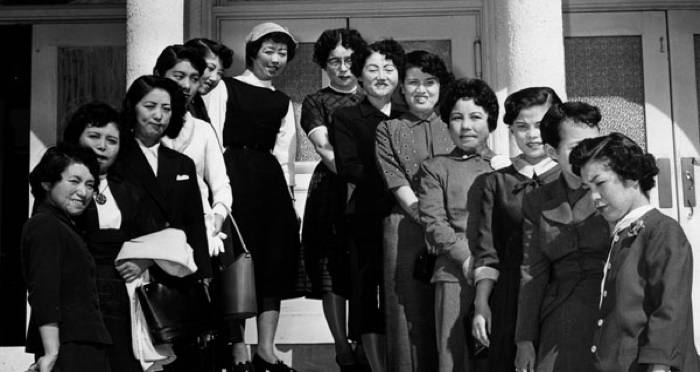
After WWII ended in 1945, there we’re many aspects of society that would need to be rehabilitated, with actual people being near the top of that list.
Among these people in need were the survivors of the Hiroshima and Nagasaki bombings, which decimated the cities and killed thousands upon thousands of people. The Hiroshima Maidens were 25 such survivors who had burn wounds that caused significant physical disfiguration. They became famous in 1955 when they toured the U.S. for a few weeks before getting reconstructive surgery in New York. Officials in the State Department worried that the Maidens coming to the U.S. and getting a lot of publicity would “generate publicity harmful not only [to] our relations with Japan but particularly [to] our worldwide efforts [to] avoid playing up [the] destructive effects [of] nuclear weapons.” (Serlin, p. 74). This quote, along with other comments made by Serlin in the same paragraph such as “The State Department feared that antinuclear propaganda, like Communist ideology, would spread and infect other grassroots movements and organizations”, tells us that the government was at least somewhat afraid of these women and the sympathy they could draw. The Maiden’s were the first burn victims that had been seen by the general American public, and lead to Americans forming a lot of their own opinions about Japan, such as that Japan was finally modernizing.
Some of the Maidens after their reconstructive surgery
Another group of people who needed rehabilitating after the war, as we learned last week, were U.S. veterans who had been injured during their service. Immediately after the war, there was not nearly enough medical care available for all the veterans that needed it. This was obviously a problem, and steps were taken to rectify it. As Dr. Sanders Marble talks about in their report “Rehabilitating the Wounded: Historical Perspective on Army Policy”, President Truman decided that the VA would take care of patients who would need more long-term support, while patients who had more immediate injuries would be handled by the military. The VA increased their fulltime physicians from 2,300 strong to 5,200 and hired thousands more residents and interns to help take care of the increased volume of wounded army men (Marble, p. 62). The report seems to paint improvements in how the government as being rather successful, which has an interesting contrast with the sentiments we saw during our discussions last week. This article (which was created by a government official) helps to show us that whoever writes history effectively decides what society thinks happened, and its sad to think about how easily the Hiroshima Maiden’s story could have been posed differently had the government been successful in controlling the narrative.
Marble, S. (2008). Rehabilitating the wounded: Historical perspective on army policy. https://doi.org/10.21236/ada483274