When discussing the rehabilitation of individuals two articles come in mind, one discusses a specific group of individuals from Japan while the other discusses the rehabilitation issues on the American home front. In David Serlin’s “Reconstructing the Hiroshima Maidens” he discusses how several woman who were affected by the atomic bomb had a chance to go to the United States to receive physical reconstruction. David stressed in this article how the reform for “hibakusha,” or the affected woman as they were called, was very physical hence the facial reconstruction. The other article “VA History in Brief” is a summary of United States Veteran Affairs policies in chronological order. This article discusses how the United States approached rehabilitation to all the returning veterans from World War II.
Both articles talk about how people physically affected by war were treated post war. David’s article was discussing a very direct and specific group of people who were effected by the atomic bomb physically while the the Veterans Affairs article is a generalization of the United States policy towards returning veterans. While David’s article was very touching and emotional it was not the norm for everyone. The VA’s article however was the opposite, it did a very well job on encompassing a nations policy; however there is no emotional touch such as David’s article.
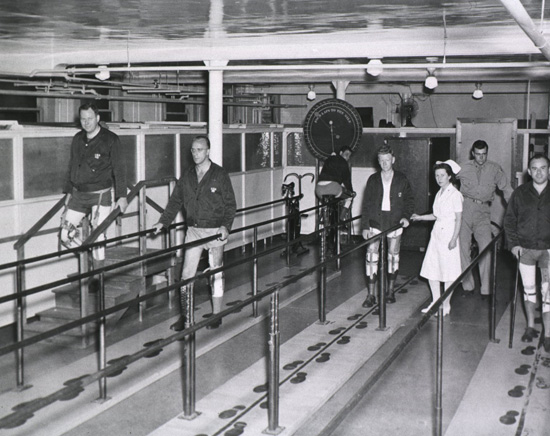
Note the physical attributes such as prosthetics being added to the soldiers to allow them to walk
David’s article tells the story in a chronological order much like a documentary, the VA’s article was a history summary rather than a story or biography. Reconstructing the Hiroshima Maidens had inferred questions as to what is the moral responsibility of the United States and how so many innocent people were affected by the Atomic Bomb. The VA’s article did not ask any questions, but did give great fact such as “existing VA hospitals were soon filled to capacity, and there were waiting lists for admission at practically all hospitals” (12) displaying how hard it was for veterans to receive attention. Both articles do a great job explaining and supporting their articles.
In conclusions, both articles support the fact that no nation was truly prepared or ready for the demobilization of war. According to David, he states that many Americans did not know or see any of the victims of the Atomic Bomb until the 1950’s and once they did the “hibakusha” were seen as a symbolic symbol. The United States weren’t even ready for their own personnel, according to the VA report “to handle the dramatic increase in veterans claims, VA Central Office staff was increased in two years from 16,966 to 22,008” (13) to try compensate for the returning veterans. There are a lot of questions that arose from reading both. From David’s article I wonder how else others were compensated for what had been done to them physically. From the VA’s article I have questions as to how they expanded in such a rapid time and where these locations were i.e. in major cities or in the boonies away from civilization.
http://www.va.gov/opa/publications/archives/docs/history_in_brief.pdf


You commented on the differences between how the authors wrote their articles, and I feel that the duality between articles based on chronology and information and those based on thoughts and feelings shows how greater history can be (mis)interpreted depending on what types of things one reads.
I too wonder what became of the rest of the Hiroshima victims. The Hiroshima Maiden program was fairly small and many women who fell under the same category as the Maidens were unable to go on the trip with them. I could only assume from what I have gathered from David Serlin’s article that they were left behind to be helped by their government in Hiroshima. Unfortunately, this most likely meant they were never helped and lived in seclusion without husbands or jobs. As for the men and children affected by the bomb, what about them? I understand that the bomb was dropped as a claimed necessity of war and it is not America’s job to send aid to its former target, but I do believe the Hiroshima Maiden program was the right thing to do and more programs similar to it should have followed. I suppose the remaining victims were indirectly aided when the Japanese surgeons returned to Japan with new surgical techniques they learned in America.
You did a really great job with comparing your two articles. I Found your second article very interesting. Both articles had similar topics, but very different attitudes. It is really interesting how two similar topics can be told in very different ways. Great post and great research!
I like how you pointed out that both articles confirmed that no nation was ready for the demobilization of war. With hundreds of thousands of soldiers suddenly being discharged from the military there was a great issue in finding jobs for them as well as having them assimilate back into society. As you stated in your post, the VA had a massive influx of veterans and they were simply unprepared to handle it.
When you pointed out how the United States and especially the Veterans Affairs were drastically under-prepared for the returning soldiers after the Second World War, it made me think of veterans today and their experiences with VA. I Know that there were already issues with veterans receiving the benefits they were promised after the First World War, but I feel that this is largely the point where Veterans Affairs became overwhelmed and it never really recovered, especially with psychological injuries and trauma being taken with increasing levels of seriousness as time went on.
As a veteran one of my concerns is that we, as a society, have to relearn these lessons after each conflict. When a service member leaves service, particularly after being a combatant, our responsibility as a society doesn’t end. Service members will need lifetime care, both physically and mentally… If we fail in this we let down the service member but potentially society as a whole….