In the years immediately following WWII, the rest of the world was forced to come to terms with the horrors the Nazi regime inflicted on Jews and other European minorities during in the pursuit of their “Final Solution.” Images of the concentration camps shocked and appalled those who did not fully realize the extent of the carnage. However, there is another event that is reminiscent of this era of brutal and systematic killing. I am referring, of course, to the Rape of Nanking.
The Nanking Massacre or Rape of Nanking, as it has been called by some historians, began in 1937 and refers to the invasion of the Japanese into Chinese territory in which the Japanese raped, pillaged, and killed the Chinese population in the city of Nanking (Chang, 4). This tragic event was noteworthy in itself but this issue was further complicated in the postwar period by the denial of the Japanese government of any misdeeds in Nanking.
Iris Chang was a historian and activist whose focus was on bringing awareness of the West to issues in Chinese history including the Rape of Nanking (irischang.net). In Chang’s book entitled The Rape of Nanking- The Forgotten Holocaust of World War II, she breaks down the timeline of the event and why it is so significant, citing the fact that it was concentrated in one city, it was carried out in a matter of weeks (as opposed to years), and the methods of torture and killing by the Japanese were especially cruel (5-6). Furthermore, Cheng believes that the denial of the Japanese government and this narrative that they have pushed has hurt the Japanese because it has deprived them of the opportunity to own up to their actions and move on. This struck me because it was evident that her argument wasn’t centered on retribution but instead on this perceived harm to the national consciousness of the people of Japan.
As a response to articles like the one written by Chang, Masaaski Tanaka penned a book entitled What Really Happened in Nanking in an attempt to set the record straight, from his perspective. A cursory search of Tanaka revealed that he was not only serving in the Japanese military at the time, but he was also a secretary to General Iwane Matsui so this certainly places his refutation of this brutal narrative in a new light (Wikipedia). In the introduction and throughout the book, Tanaka seeks to systematically tear down the timeline and proof that Cheng and other academics have offered that this terrible event happened, making use of loaded terms like “invention,” “conspiracy,” and “fabrication” to describe accounts of the massacre (viii). In response to Tanaka’s claims that the massacre did not actually occur, I have several questions: What do the Chinese gain from the fabrication of this story? Victimization? Any kind of upper hand? If it was a fabricated story, how would it become so deeply imbedded in the national consciousness? I’m not saying that it is impossible, but what would the real motivations and benefits be if it was false?
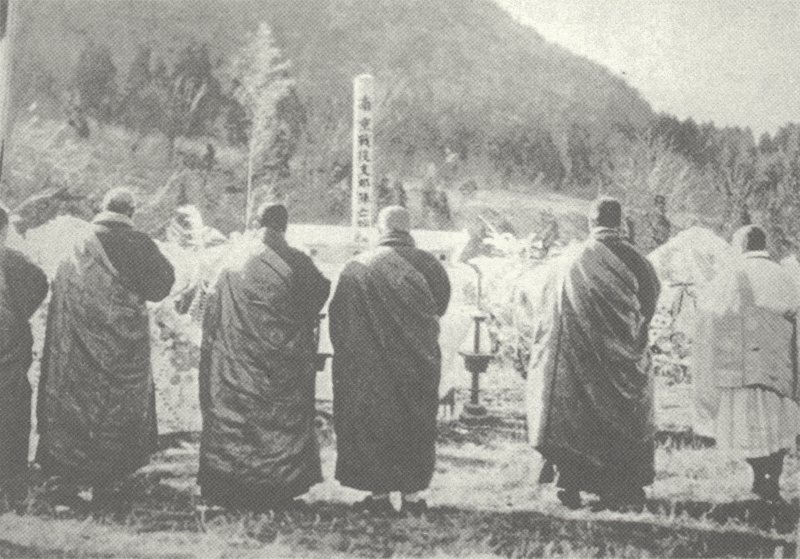
One of the photos included in Tanaka’s book which he claims depicts a memorial service for the fallen Chinese
This photo below presents even more questions for me. Tanaka includes this photo in his book to make the case that the Japanese had memorial services for the fallen Chinese of Nanking (126). Then, he makes the connection that if they had this kind of service honoring the dead, they surely would not have committed the heinous acts that they were accused of (126). Even if one takes his word that that is what this photo is depicting, how does that disprove these accounts of brutality? This was just one example of Tanaka’s that I found to be weak in proving his argument but I think that it speaks to the Japanese logic surrounding the events at Nanking.
Even though it seems obvious from a Western perspective that this event did, in fact, occur, we will continue to be pulled back and forced to reexamine the evidence until the international community can come to some understanding and address that reality. Ultimately, this ongoing dispute over the events that occurred in Nanking speak to the larger issue described by Chang: Because the issue is still so contentious, there is no way for both sides to move on from the tragic event and gain some sense of healing.
Background on Chang-http://www.irischang.net/about/
A video on Chang talking about her research for The Rape of Nanking– https://vimeo.com/21218528
Background info on Tanaka-https://en.wikipedia.org/wiki/Masaaki_Tanaka
Text from Masaaki Tanaka- http://www.sdh-fact.com/CL02_1/7_S4.pdf
Photo- http://www.ne.jp/asahi/unko/tamezou/nankin/whatreally/chapter1517.html


Why do you think there is always a comparison between the Jewish Holocaust in Europe and the Nanking Massacre in China? Do you think this is a fair comparison?
I really liked how you brought up the confusion that surrounds this topic. I think there is so much controversy and tension around this event partially because of this; there is not concrete evidence of what exactly happened. This makes it easier to just gloss over and not look into, because trying to figure out the truth can be too complicated.
I like the argument you make about how the photo’s Tanaka selected do not justify the argument he is making. I thought a similar thing, that the claims he was making did not really refute many of the accounts of violence by the Japanese soldiers. I agree that his logic is symbolic of the thinking of many people who deny or argue about the Nanking Massacre.
In regard to your picture, do you believe that honoring the fallen Japanese excuses the massacre? Is it just a shallow way to justify what they had done?
Your argument regarding the photo that Tanaka uses is interesting, it asks a question that some people might overlook. If this is an accurate picture of what took place after the battle do you think the Japanese did this to prevent talk of the massacre? Did the Japanese know that hey will eventually need to defend what they did in the city?
Chang talks about in the reading that one possibility that the massacre did not get the worlds attention like Hiroshima and the Holocaust was that the victims remained silent. This is large impart to geopolitical history but also how Japan as a whole was willing to go to extremes to cover it up.