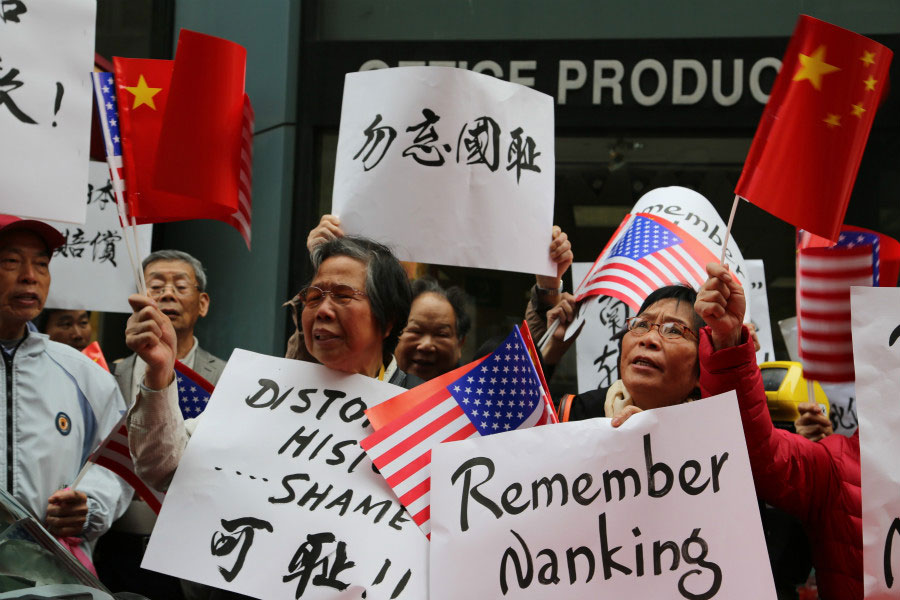
Hundreds protest in front of the Japanese Consulate in San Francisco over Japanese Premier Minister Abe Shinzo’s refusal to admit the country’s war crimes.
The above image shows Chinese and Korean protesters outside the Japanese Consulate, signs and chants voice their outrage, reverberating off nearby buildings and echoing through the past. But why would there be controversy over an event so far removed from the present?
The main controversy that has existed over the Nanjing Massacre, or Rape of Nanjing, for the last 70 years is whether a massacre ever happened at all. For the majority of academia and East Asia, as well as author and human rights activist Iris Chang, the Nanjing Massacre was just that, a cruel and horrendous massacre that occurred in 1937 during the Japanese invasion of China. But for some, like Japanese author Tanaka Masaaki, the Nanjing Massacre was an elaborate hoax made to tarnish the image of postwar Japan. Both authors have provided research and evidence for their arguments, but the most intriguing part of the entire issue comes down to why there was ever a disagreement about the truth in the first place, and why that controversy is still taking place today.
The main source of contention, documentation and proof, are both abundant but at the same time disputed. For Chang the evidence was clear, many Chinese survivors were credible witnesses and there were even foreigners there to record the events. To augment the eyewitness accounts, Chang used the data collected by the International Military Tribunal of the Far East (1946). According to the IMTFE, at least 260,000 noncombatants died in Nanjing, though many experts believe that figure is over 350,000. Furthermore, Chang cited the soldiers who had participated in the Rape of Nanjing and later gave interviews about the incident.
For Masaaki, these interviews were nothing but a farce and a disgrace to the honor of Japan. Masaaki, like other Nanjing deniers, believed that all the evidence that Chang and other Nanjing Massacre researchers cited was fabricated “The inflammatory prose that characterizes The Rape of Nanjing is rife with accusations that are simply untrue and descriptions of despicable, horrific crimes that were never committed” (Masaaki, 1). Masaaki claims that all the photographic evidence showing the Rape of Nanjing was fabricated, and that all the eyewitness accounts were lies. Attempting to further his case, Masaaki describes the character of the Japanese general who commanded the assault against Nanjing, General Matsui. According to Masaaki, Matsui had erected a shrine to both Japanese and Chinese dead, and that all other deaths were military causalities taken in the battle of Nanjing “Would an officer as honorable and ethical as Gen. Matsui have ordered or sanctioned the massacre of 300,000 Chinese?” (Masaaki, 4).
In addition to the cold hard facts, both Chang and Masaaki made use of emotional and personal appeals to further their arguments. Chang especially tries to highlight the importance and significance of the Rape of Nanjing with vivid descriptions of the atrocities, because she believes “The Rape of Nanking should be remembered not only for the number of people slaughtered but for the cruel manner m which many met their deaths” (Chang, 6). Chang also uses personal experience and stories told to her by her parents to create an emotional connection, a tactic that her opponent Masaaki used in equal measure “When I heard that William Webb, the presiding justice at the Tokyo Trials, had sentenced Gen. Matsui, the man whom I respected more than anyone else on earth, to death by hanging, I was devastated – so much so that I couldn’t eat” (Masaaki, 5).
For Chang, the Rape of Nanjing was glossed over in history, being overshadowed by the atomic explosions and the Jewish Holocaust, especially in the western world where it would often appear little more than a footnote. Worse yet, Change believed that the Rape of Nanjing was covered up so that it would not damage U.S. Japanese relations during the Cold War. Also finding U.S. Japanese relations pivotal, Masaaki wrote how the existence of a true Nanjing massacre would severely damage the image of Japan and strain its friendship with its greatest ally. According to Masaaki, the reason that had had to write, was to correct this fabrication of history, directly challenging Chang’s work “I urge American researchers, politicians, scholars, journalists, and opinion leaders to read it. Once they have, I am convinced that they will arrive at the realization that violations of international law of the magnitude alleged by Iris Chang in The Rape of Nanking (more than 300,000 murders and 80,000 rapes) never took place” (Masaaki, 5).
Of all major WWII events in the Pacific Theater, Nanjing has become the most controversial because of its scale, brutality, and consequences. Author Takashi Yoshida explains the phenomenon in his article The Nanjing Massacre, Changing Contours of History and Memory in Japan, China, and the U.S. “how the subsequent treatments of an historical event across national boundaries can reveal more about the anxieties, prejudices, and political agendas of its commentators than about the event itself” (Yoshida, 1). The fact that Japan was capable of killing over 250,000 innocent civilians, in many cases torturing them to death, is not only unimaginable to the post war-world, but often unacceptable, thus creating Nanjing Massacre deniers and historical revisionists. With national honor and morality on the line, revisionists like Tanaka Masaaki feel that it is their civic and personal duty to correct the past, leading authors and activists like Iris Chang, to write and speak out until the all the world knows the truth of the past.


It’s interesting to see how Chang and Masaaki view the events in Nanjing. They offer two opposing views and you covered them well. The documentary we watched seemed to have a strong focus on people in Japan trying to acknowledge the massacre. What did you think about the documentary’s approach?
I think it’s interesting how it’s questioned that such a large scale event happened at all. I think this confusion and the extremes that surround the massacre make it “untouchable” for a lot of people studying history.
I think it is interesting you bring up the “emotional appeal” of their arguments. When reading the articles, I did not imagine that Masaaki would provide a compelling argument in favor of General Matsui. However, he is able to use emotion to make the reader question whether these atrocities could be committed by a man as noble as Matsui. Conversely, Chang uses emotion to make the reader sympathize with the victims. Both approaches are effective and make for a compelling discussion.