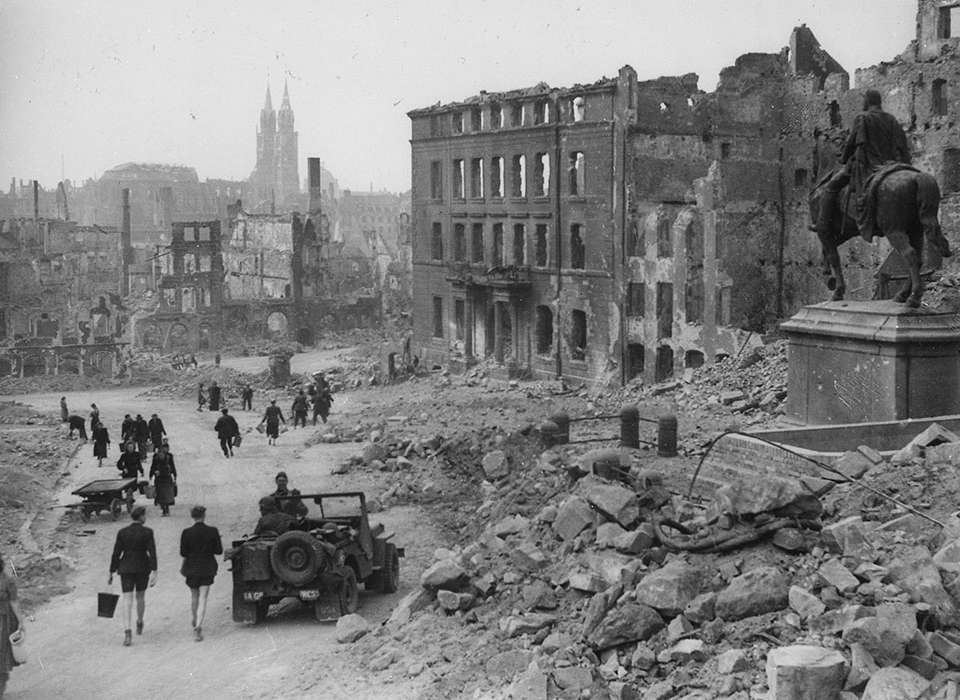
After WW2, Europe was devastated and in need of assistance to reconstruct their cities and societies. A major form of help they got, and what I would argue to be the key factor that allowed Europe to repair itself, was the Marshall Plan. The Marshall Plan provided aid to all European countries except for Spain, even offering the Soviet Union aid, though they turned it down. The plan gave European nations over $15 billion, which allowed them to redevelop their cities and infrastructure much more quickly than they would have been able to on their own.
Scene of a European city reduced to rubble by the war.
The United States used their newfound leverage over the recovering countries to heavily promote consumerism and international trade with them. This made the U.S. an even bigger economic powerhouse than it was formerly, as having all these countries be reliant on you allows for a lot of control over their economic decisions. The U.S. even spread their ideal of mass democratic consumerism to Japan (pg. 20), but it wasn’t immediately successful as Japan’s culture around living conditions and ideals were too drastically different from those held in the U.S. and other western nations.
I think the way that the U.S. used the end of the war and its facilitation of reconstruction to essentially shape these rebuilding nations was a smart move, but was it within their rights to do so? They were the least directly effected by the war, and were in a position to provide significant financial and otherwise aid to nations that needed it, but in accepting this aid did these countries effectively sign themselves over to rebuild themselves only in whatever way the U.S. saw fit? This is probably a reasonable trade-off in my opinion, and I do believe that the way the U.S. used this to promote strong democratic nations and slow/halt the spread of communism to be a good thing. However, having a nation flex its power over others could quickly lead to a more dominant relationship between nations, and especially now that after WW2 the U.S. has begun to maintain a massive peacetime military that could threaten every other country on the planet at once, could lead to a situation scarily close to a sort of world domination through the lens of (in this case American) ideals superiority.
Author: cagan
3 thoughts on “The Impacts of Reconstruction on the Postwar World”
I like that you asked the question of whether it is was morally right for the United States to rebuild European and Japanese economies in their own image. I think that how these questions are viewed in different times is important for understanding the evolution of the historiography on a certain historical event.
While consumerism post-WWII was a good thing for other countries I think it benefitted the US the most. It strengthened their economy but, as you suggest, it gave the US more power. Because of its influence after WWII the US has much more influence worldwide than many countries especially when it comes to the military.
I think that the manner in which you presented the information was extremely beneficial to the audience. This is due to the your ability to concisely summarize and apply the authors argument into your summary. Overall, I think you did a great job with this post, good job.


I like that you asked the question of whether it is was morally right for the United States to rebuild European and Japanese economies in their own image. I think that how these questions are viewed in different times is important for understanding the evolution of the historiography on a certain historical event.
While consumerism post-WWII was a good thing for other countries I think it benefitted the US the most. It strengthened their economy but, as you suggest, it gave the US more power. Because of its influence after WWII the US has much more influence worldwide than many countries especially when it comes to the military.
I think that the manner in which you presented the information was extremely beneficial to the audience. This is due to the your ability to concisely summarize and apply the authors argument into your summary. Overall, I think you did a great job with this post, good job.