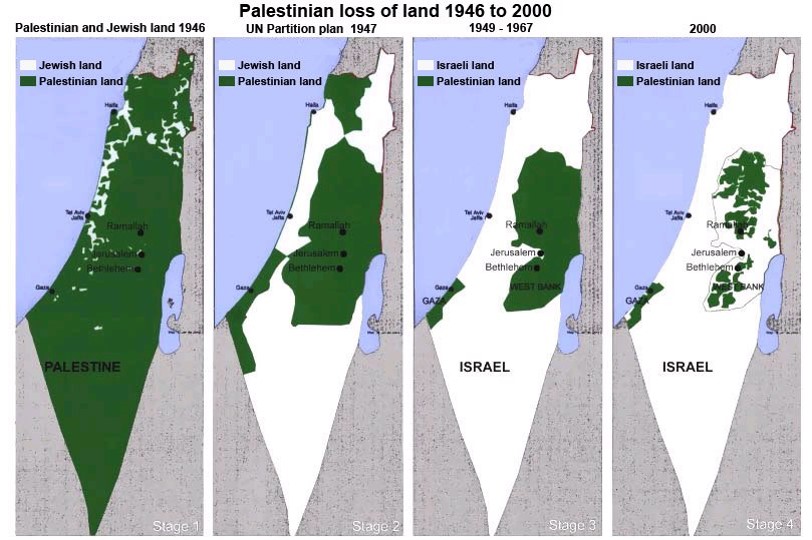
 The Middle East was a turbulent place following the end of World War with the formation of new states in the area. The most controversial of the states created was that of Israel because it took land form the Arab state of Palestine. Israel took more land from Palestine through an attack after the British pulled out of the land, this led to many people becoming displaced. This displacement included a lack of ability to go back for 20 years; this led to different understanding when they were allowed back.
Ghassan Kanafani discusses one way in Returning to Hafia, in which a man goes to his house from before the Israeli attack and finds it inhabited by Israeli people. These people also raised the mans son that he had lost during the invasion for the 20 years and taught the son how to be jewish. Upon meeting his son Said, the man in the writing, realizes that he has embraced the Jewish lifestyle and that he was truly the Jewish families son (Kanafani, 179). This leads him to understanding of what a homeland is which is where understanding change. He believes that a homeland is something to look forward to in the future, even through war, not just something to look at in the past (Kanafani, 187).
This is interesting because in another source, Nakba by Ahmad Sa’Di and Lila Abu-Lughod, a reader gets the understanding that the homeland is where the person is presently. This is another story about a man being forced out of his home during the Israeli invasion but this one the man goes to the United States and becomes a citizen. This means that he was able to go back to his home during the 20 year period where others weren’t. Eventually he moves back to the new Palestine because he wants to be with these other people. It appears as though he is content with living this way on not finding a need to go back.
These different ways of thinking have shown through the conflict in the Middle East over Israel and Palestine. There are people who believe in a two-state solution in which both people can live peacefully, i believe this can be seen in the second source Nakba. He showed his family around the town he used to live in and seemed to be content with that (Sa’Di & Abu-Lughod, 82-91). He didn’t seem to want to have it back under the control of Palestine immediately and didn’t seem to need it. He enjoyed showing his family around even though it had been changed to be more Israeli which is an understanding in a two-state solution.
The source by Kanafani shows a person behind a more one state solution to the dispute. He believes that the only way to feel like he is back at his homeland is to be in that land under Palestinian control, he is even willing to go so far as war (Kanafani, 187). This is the understanding in a one state solution, only one person can prevail and have the homeland that they want. This is what has caused most of the modern day problems between the two states. It is a problem on both sides that needs to be addressed so that people can be able to visit their old homes and live the way they want.
In the end the problem is the understanding between the two groups of people, in both stories the Israeli people were open to meeting those who formerly owned the houses. They discusses with the Palestinians and some only met the Israelis with hostile. There is animosity between the two groups that needs to be dealt with before the area can become what people want.


You reference the fact that in both stories the Israelis are open to meeting those who had once owned their houses. However, in actuality in the Abu-Lughod article the man whom owned the house was not an Israeli but another Palestinian.
I think that the Kanafani text in particular does a good job of asking the hard but necessary questions. For example, is the return to the homeland a physical return or a return to a way of life? Or both? Are either of these options actually feasible? Is there really a way to rectify this issue other than to acknowledge the fact that the Palestinians were forced from their homes in a brutal manner similar to the Jews of Europe? This this switch actually fix anything?