A DP is a term that nations use to generally describe a large group of people otherwise known as refugees. Over the years there has been a movement to standardize the treatment of these people and thereby make them more easy to deal with. However, due to the overwhelming number of refugees following World War II the process did not fully do justice to the individuality of these people. The focus became funneling people out of one place and into another. As a result the governments sought to remove the agency of refugees and disregarded what was most beneficial for those individuals that constituted this group denoted as DP’s.
It quickly became far less about what these countries could do for refugees and far more about what refugees could do for these countries. For example, Gerald Cohen, the author of In War’s Wake, describes the French as wishing to select which refugees would come into their country. He even stated that the French rejected up to fifty percent of refugees that sought out asylum there. The French even went so far as to fear that Belgium and Great Britain had already taken the most desirable refugees. Members of the French government were quoted saying that “what remains available, looks to be of bad quality” (Cohen 107). They then went on to discuss that the French government was looking for strong young men to fill their need for hard labor. In these statements, the French not only dehumanized these refugees that were seeking their assistance but implied that their only worth to the nation would be as menial workers.
Refugees quickly became numbers, much like the young boy below. It became far more about how many refugees they could take care of than the quality and the individualization of that care. This can be demonstrated by the strong emphasis on numbers by the IRO and other refugee organizations. Similarly, refugees are also described in massive wave-like terms. This was done in order to make the refugee “problem” seem like one of massive importance that must be dealt with immediately.
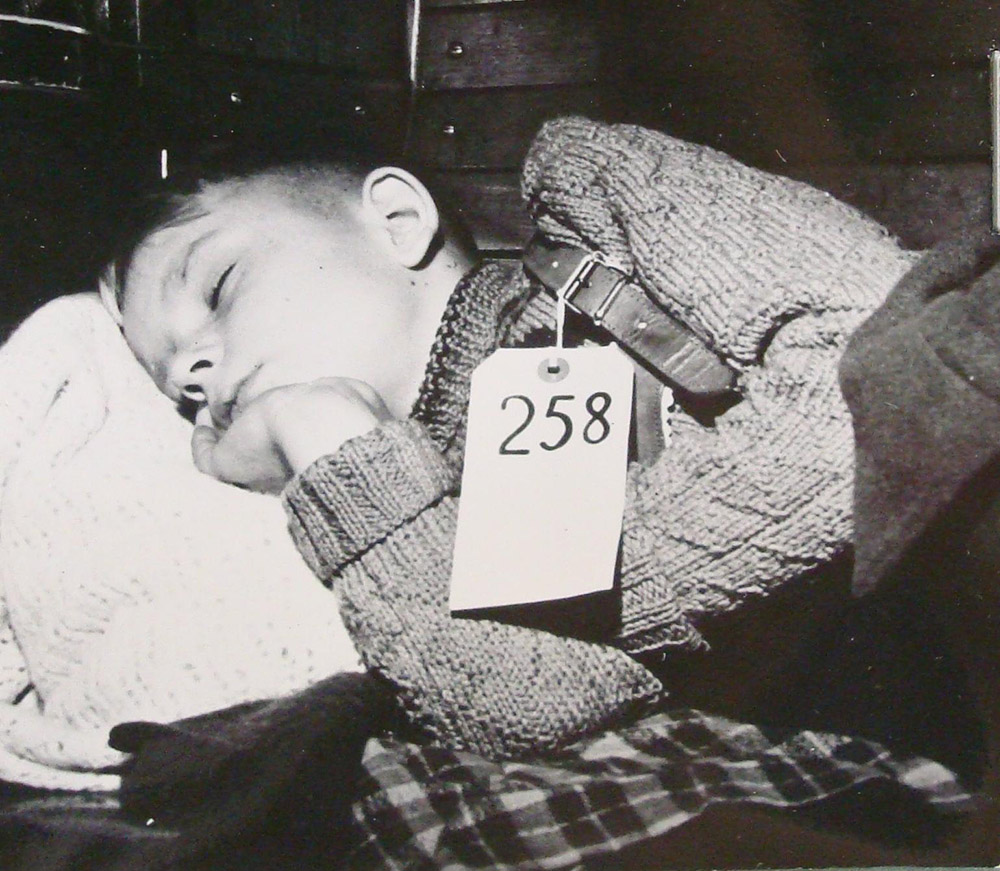
This picture depicts a Jewish refugee in the care of the IRO numbered with the number 258 https://www.archives.gov/files/publications/prologue/2012/summer/images/pupa-homeless-boy-l.jpg
Another particularly disturbing portion of the reading by G Cohen was that of the IRO attempting to “market its refugee population” (Cohen 110). The implications of this are extraordinary. The use of the term market links these people to simple products that a company is trying to sell and get the most they possibly can out of. However, once again, this entirely fails to take into account the humanity of this “product”.
The presence of DP’s in post-war Europe was constantly described as a crisis. However,this crisis was certainly depicted as one for the governments that had to deal with these people. While in actuality the refugees themselves were in a crisis. They needed the help of those more fortunate than themselves, but were constantly referred to as an unwanted “surplus” (unless of course they were in the desired demographic for manual labor).
At the end of the day, humanitarianism comes down to a desire to aid others. It implies a level of selflessness. By simply examining these refugees as potential workers these countries proved themselves to be the opposite of humanitarians, and revealed themselves to be opportunists.


It is interesting to compare this topic to the last time we covered displaced persons. For France, they seemed to only consider taking in potential workers and young children of French descent. This dash to get as many possible workers was massive after the war and brought up many questions about who can be let in.
I think the image you chose for this post really added an emotional aspect to your post. I think it’s easy to forget during huge crises such as these that these numbers of refugees are real people. I also really like the connections you made in class to our earlier discussion of DPs, and how they were seen more as a resource than from a more humanitarian point of view.
When Cohen wrote that DPs were seen as just numbers in a labor force, who was he referring to, government officials, immigration workers, factory owners? Its hard to speak for an entire country when only the views of a few in high places will actually be recorded.
The picture you put in your post powerful due to the fact that he is marked with a number. This to me is a great example of the attitudes about displaced person after the war.
I loved your analysis of the relationship between removing the agency of the DPs and the ways in which their value as a commodity was determined. I would agree that this trope of the ‘anonymous refugee’ plays a huge role in the kind of treatment they receive. I was also appalled at the descriptions of these individuals as ‘undesirable’ to nations and it truly reveals the motives of nations in their willingness to accept these refugees. I like how you tied in your photo of the child as represented to a number because it really speaks to the attitude so many nations had toward the refugees.
The use of numbers is interesting because it could easily be compared to the Nazi of numbering of people in concentration camps to make them less human to the guards. The IRO seems to want to dehumanize the DPs in this instance so as to make them more beneficial for the states that need workers. They are definitely focused more on the exploration of workers and not the humanitarian cause that they should have been, as you say in this post.