As discussed in a previous post, the end of World War II and the resulting crisis of displaced persons in Europe culminated in the United Nations working out what qualified a state to claim people as its citizens and repatriate them. During the negotiations between the United States and the Soviet Union on the matter, the term “human rights” came into play to describe a person’s inherent right to belong to a nation, thus characterizing the U.N.’s mission to return DPs to their home country as a morally just action. This was largely true, though an unpleasant fate sometimes awaited repatriated citizens of the U.S.S.R. This was how the idea of human rights rose to international prominence in the postwar era.
The existence of human rights is an old concept, with much being written on the topic during the Enlightenment. In general, the term “human rights” encapsulates all rights which a human being can not be denied by their state, simply for the fact that they are a human being. In the postwar era, human rights were emphasized because of the shocking inobservance of them during WWII. The infamous Holocaust perpetrated by the Germans, the rape and/or murder of approximately 10,000,000 Chinese citizens by the Japanese military, and the deaths of millions more civilians at the hands of both sides in the name of acceptable civilian casualties for the sake of victory all demonstrated that the world’s nations desperately needed to be held accountable for how they treated human life (Wikipedia)
Historian Mark Mazower of London’s Birkbeck College wrote a paper about how codifying human rights grew to be one of the U.N.’s greatest aspirations: The Strange Triumph of Human Rights, 1933-1950. As Mazower points out, human rights did not come to such prominence simply because atrocities were committed during WWII, but also because defining (and having a say in defining) human rights gave the world’s leading powers an unambiguous position of ethical authority. Before the application of the term “human rights” in the postwar period, the term “minority rights” was used. “Minority rights” was more specific a label than “human rights,” and therefore enforcing minority rights was a much more meticulous task that, in the eyes of world powers, was not worth the effort of performing (Mazower pg. 382) Moreover, the League of Nations did not provide any means of recourse against a nation which violated minority rights. The solution to this problem was to use the new, broader label of “human rights” in the U.N.’s laws. It was a fresh start.
Importantly, this decision gave the U.N. the power to define laws and punishments with actual backbone. More importantly, world powers, specifically the U.S. and U.S.S.R., could henceforth use the pretext of enforcing human rights to get involved in the affairs of less powerful countries. Thus, the pursuit of protecting human rights opened up a giant new window for the Cold War to be amplified as the two superpowers, both permanent members of the U.N. Security Council, now existed in a world where a state could be justified in interfering with another’s affairs for the sake of human rights. This was not necessarily a bad thing for the actual mission of protecting human rights, but it guaranteed that human rights would always be politicized so long as the Cold War continued and the rest of the U.N. depended on the U.S. and U.S.S.R.’s cooperation.
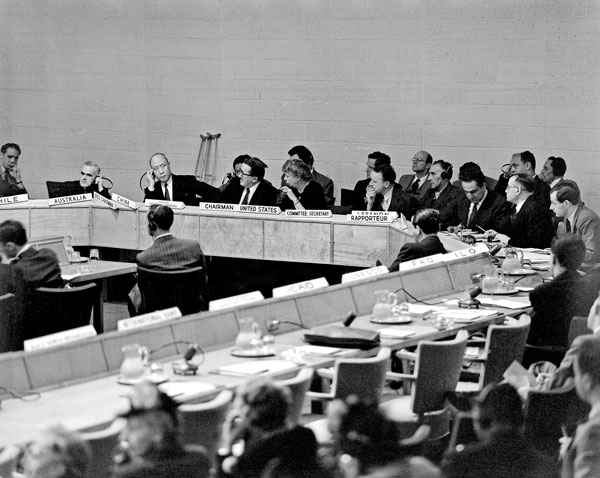
The United Nations Commission on Human Rights
Pictured here is the U.N. Commission on Human Rights convened in 1947 to draft the International Declaration of Human Rights, with Chairman Eleanor Roosevelt representing the U.S. Roosevelt was a vocal proponent of human rights even before she was appointed to the U.N. General Assembly by president Truman. This again relates back to the DP crisis following WWII, wherein Roosevelt acted as one of the leading voices speaking up for the protection of people’s human rights in the face of possible deportations and repatriations to countries which did not respect human rights.
Bibliography
Augusto Cançado Trindade, Antônio. “Universal Declaration of Human Rights.” United Nations. United Nations, 2021. https://legal.un.org/avl/ha/udhr/udhr.html
Mazower, Mark. “The Strange Triumph of Human Rights, 1933-1950,” The Historical Journal 47.2, 2004.
Wikipedia. “Japanese War Crimes.” Wikipedia. Wikimedia Foundation, September 27, 2021. https://en.wikipedia.org/wiki/Japanese_war_crimes.


The enforcing of human rights on a global scale, as you pointed out, was an incredibly important and valuable tool for human rights to be able to abound. It is a great question, however, of how things would have looked differently if the Cold War had not been looming. Would the enforcement of human rights been so politicized had the world not been divided into two political camps? Of course, asking questions like this is rarely helpful in coming to greater historical conclusions, but it is still something interesting to explore.
I thought it was interesting that you mentioned the politicization of human rights. Broadening the term to human rights in theory helps a greater amount of people. However, it turned it into a political game where powerful countries are in control. This allowed countries like the United States to continue mistreating their own minorities.
It is interesting that the global powers wanted to emphasize human rights but not the more defined minority rights. It seems as if these global powers only want to support an issue if they get to be included in it as well.
I thought it was interesting how you use the artifact to emphasize the UN. I think that this was particularly important as you used this artifact and the topic of the UN as the centerpiece. Overall I think that you did an excellent job of including your artifact into the discussion of your blogpost.