All the king’s horses and all the king’s men came rushing to the aid of Humpty Dumpty. Certainly, they did not only try to help him, but they discussed the situation as well. What might they have said? Some of the men may have blamed the wind for pushing poor Humpty off of that wall. Others might have blamed Humpty for being so naive as to put himself in a position to fall. Aiding Humpty could have brought great controversy which would have caused it to be far more difficult to put him back together. Humpty’s shells, those bits and pieces scattered across the ground, are the displaced persons throughout Europe. The great controversy was who was to bear the guilt of the outcome of this scattering, and who was going to sow the new world for the reaping.
Gerard Daniel Cohen suggests that this controversial question “formed the core of the East-West controversy” (In War’s Wake, p. 23). Who bore the guilt of the atrocities of war? The Western powers answered this question by their actions. Cohen argues that the Western powers completed their “violent phase of retribution and purges” fairly early in the reconstruction process (In War’s Wake, p. 25). The Soviets, however, had a different approach. Polish prisoners were taken and forced to work for the German army. They were attempting to survive, and, thus, were complicit in some of the actions perpetrated by the Nazi regime. The Soviets saw this as a reason to punish those displaced persons coming back into Eastern Europe at the end of the war. The grand question becomes: what is the historical lens which is taken in the twenty-first century? Does modern thought subscribe more to the Western perspective of the issue or the Soviet perspective?
The reflection of Atina Grossmann shows the reality that modern thought doesn’t really know what to think. She points out that “just announcing… facts about the massive incidence of rape… [by] the Red Army… is enough to provoke enormous anxiety… [from those] who are otherwise not averse to documenting… male violence against women” (“A Question of Silence,” p.45). If these Polish DPs were technically complicit in some way, then did they deserve the retribution that they received? If they were caught in the crossfire of the massive rapes, was that just a side effect of war? Should they be allowed to return home as rescued victims or incarcerated perpetrators? Once again, Cohen argues that this is not as simple as hindsight tries to make it. The US and British officials knew this as well. The goal of the Western powers was to protect people, they wanted to individualize guilt. They began “focusing instead on the prosecution of high-profile collaborationist leaders” (Cohen, In War’s Wake, p. 25). This freed them up to look at the needs of the people who were really caught in the crossfire, those people that were just blown off the wall whether they should have got onto it in the first place or not. This was the concern of Eleanor Roosevelt, as Cohen quotes to have said, “[The United Nations is] trying first and foremost to take into account the rights of man, not the rights of government” (In War’s Wake, p. 28). As wonderful as this sentiment was, the outworking of the United Nations proved to be the exact opposite of this.
The horrors committed against women by the Red Army did not end the humiliation that women faced in the postwar era. In the displaced persons crisis that followed the war, many women had their children stripped from them, by Western and Soviet powers. This was an attempt to regain populations, particularly in France. The argument was that these German women were unable and unwilling to care for their children, which created a whole subset of displaced persons that may not have needed to exist. The punishments were bore by “women who had (allegedly) enabled the [French] enemy to penetrate their bodies” (Zahra, “A Human Treasure,” p. 334). The French became the king’s men who argued that Humpty was to blame for his own demise for getting himself up on the wall in the first place. The outworking of this blame, then, was to sow national sovereignty and power once again. The international organization that Cohen argues was trying to help people throughout Europe was actually helping the world get itself back into the old ruts of national prowess. While Cohen argued that the UN was attempting to make the world better for the individual, as Eleanor Roosevelt expressed, Zahra argued that they “ultimately anchored long-standing nationalist ideals at the heart of new international regimes of refugee relief and rehabilitation” (“A Human Treasure,” p. 350). Can Humpty be put back together again?
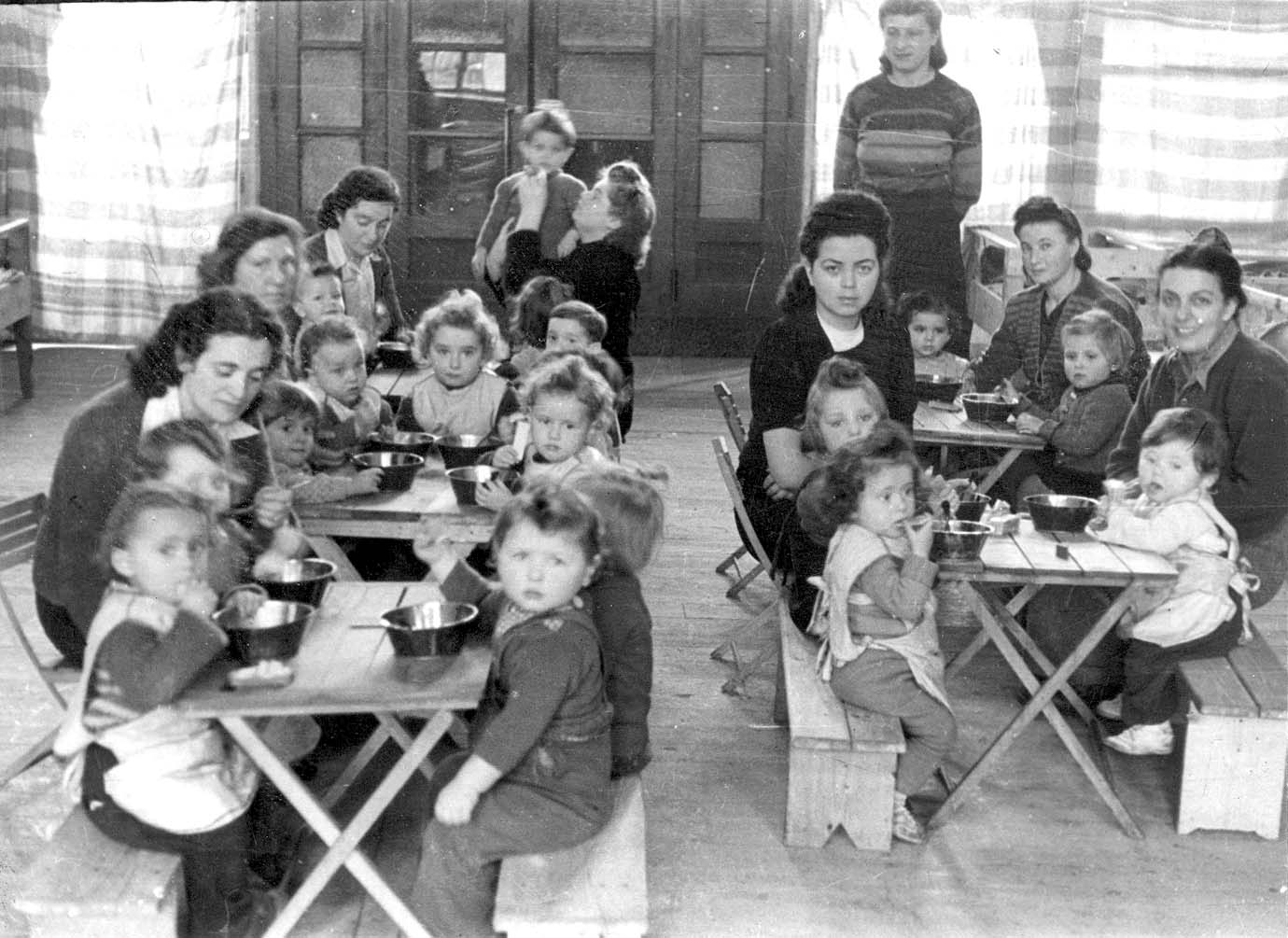
The question of displaced persons plagued the minds of the men and women trying to put the world back together again. Unfortunately, the question of displaced persons has not ceased today. Did the controversy prevent the world from being pieced back together in a manner more attuned to internationalism? In all likelihood, it did. However, it is impossible for this to change what has actually happened. The scattered eggshells have left the twenty-first century thinker with questions that they must ponder. Ultimately, it is impossible to change the past. However, the question still remains: who bears the guilt? This will always be divisive. Was it the Nazi regime that manipulated its people (the wind)? Or was it the complicit bystanders who just kept going through life (Humpty put himself up there)? The unsatisfying reality is, this debate will never come to an end. Even here, the conclusion has become even more unsatisfactory: it is a combination of both.
Bibliography
Borowicz. Salzburg, Austria, A kindergarten in a DP camp, Postwar. Photograph. Yad Vashem. September 10, 1991. https://photos.yadvashem.org/photo-details.html?language=en&item_id=75157&ind=32
Cohen, Gerard Daniel. In War’s Wake. Oxford: Oxford University Press, 2012.
Grossman, Atina. “The Rape of German Women by Occupation Soldiers.” October 72 (Spring 1995): 42-63. http://www.jstor.org/stable/778926.
Zahra, Tara. “‘A Human Treasure’: Europe’s Displaced Children Between Nationalism and Internationalism.” Past and Present 210, no. 6 (2011): 332-350. https://doi.org/10.1093/pastj/gtq053.


Some of the Allies truly believed that they were justified in their acts against German women because of the horrors the Nazis had inflicted. I always find it slightly ironic that while the Germans were being tried for war crimes, the Allies were actively committing some of the same crimes. People wanted the Germans to pay for their actions and so they targeted the vulnerable. The French decided to take half-French children from their German mothers, claiming that German mothers were unfit. They believed they were reclaiming what was rightfully theirs because of all the children the Germans had taken from them. The Allies had their own mindset of how many people were complicit in the Nazi regime, and they all had different ideas on how to punish the Nazis.
I really like the metaphor about humpty dumpty especially because you tied it through the entire post. As well as the title all very creative and very bloggy. The focus on where the guilt lies was good/interesting lens through which to view these articles. It brought different points and evidence to light.
“All the king’s horses and all the king’s men came rushing to the aid of Humpty Dumpty” love this as an opening sentence. It really captures the urgency to tend and mend Europe and the DPs, but it seems like all the haste came out of a place of personal goesl of the allied forces rather than directly thinking about the needs of the DPs.
The title and theme throughout the article of Humpty Dumpty and applying that metaphor was excellent and entertaining. Using a metaphor this creative while properly analyzing the arguments and perspectives of Zahra and Cohen was quite impressive. Great job coming up with a unique way to draw the reader in and also deliver on the writing of a quality blogpost.