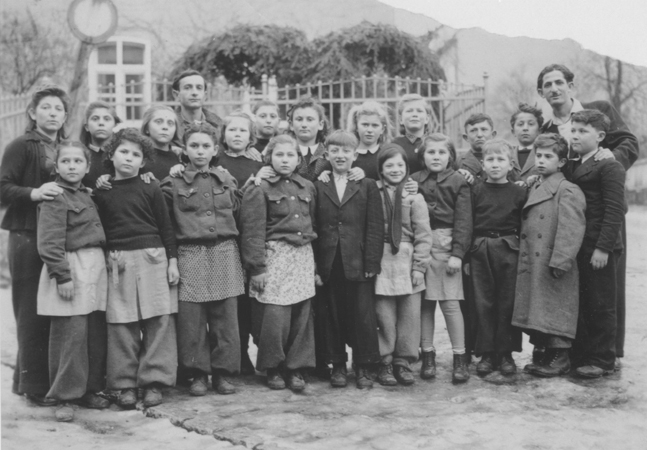
The reason that I chose this photo is because it exemplifies the role of children in the years immediately following the war and how they fit into the national versus international debate. As the caption states, this photo is from one of the Displaced Persons camps established after the war in which children would go to live with people of the same nationality to rebuild a sense of community. While the photo does not show a large group, there is a sense of cohesion amongst the members of the group; they all look similar and appear to be wearing similar clothing. This initiative to revive national identity is ironically rooted in the international humanitarian relief efforts that brought them together in an effort to secure a hope for the future of Europe through its children. Furthermore, I particularly wanted to focus on the displaced children because they are the main focus of the first reading which I found to be the most interesting. Every time that I have discussed WWII in an academic setting before, the focus has been on the death tolls and the destruction of major cities in Europe but I’d never truly considered the effects on the women and children who were left behind.
In ‘A Human Treasure’: Europe’s Displaced Children Between Nationalism and Internationalism, Zahra explores the circumstances that caused the forced repatriation of so many children immediately following WWII, citing logistical as well as political reasons from both sides. For me, this was eye-opening because it was shocking to find out the extent to which these children were redistributed across Europe in the name of their own “best interest”. It also introduced something to me that I hadn’t ever considered before which is that rebuilding Europe after the war was just as much about restoring the people and their culture as it was about rebuilding the infrastructure that allows the nation to run smoothly. Of course, while it is obvious that the populations of Europe suffered great losses because of the war, it isn’t immediately obvious that the Allies would seek to remedy this problem through laying claim on children of mixed European descent. The context for this is an interesting one too because in the wake of a war that causes displacement of this magnitude, the last thing that I would have expected is for nations to try to actually take people currently settled in other nations.
In contrast In Wars Wake, delves deeper into the logistics of dealing with displacement and takes a more by-the-numbers approach, specifically with an emphasis on the so-called “last million”. There is also a heavy emphasis on the development of various international organizations newly tasked with addressing major humanitarian crises and exactly how they went about trying to fix this problem. One comment that struck me in the Introduction was the idea that these displaced people did not wish to return to their homes from before the war, specifically Jews who had narrowly escaped the terror of the Nazi regime. This is obviously understandable, but it made me think that this is one way in which the reason for which a person is displaced has a huge impact on their attitude toward their displacement. For example, in this case where the displacement is due to war there was a huge population that had no desire to return to their homes. This is quite different from populations that are displaced due to natural disasters and desire to return home and rebuild. For me this delineation was important because the language in which we talk about displacement is largely the same for either situation but they are actually very different in nature.
Together, these readings provided a multifaceted explanation for some of the major questions surrounding the displacement of millions. That being said, there are still some topics that I would like to follow up on: I liked that the second reading touched on the influence of the media, specifically in the US, in procuring funding for operations to care for these displaced persons. How much of this funding actually came from the US? How much of this funding that is attributed to the US is overinflated? Additionally, in the second article, there is some discussion regarding the attitudes of the West (US) versus those from the East (Soviets) about the responsibility of resettling the refugees in which the author clearly supports the West in their interventionist method and shows disdain for the East’s apathetic approach to the refugees. I would be curious to know if this is a valid point regarding the callousness of the Soviets or if they did in fact contribute, just not as much as the US did. Much of what I understand about the aid provided to the refugees is that it primarily comes from the US, but is this the case or is it just because of the bias of sources coming out of the West?


Your discussion of how not only buildings and infrastructure had to be rebuilt after WWII but cultures and people too is very important to a full understanding of the post-war fallout. Children too especially had to rebuild because war was all they knew.
Do you think since that children after WWII were viewed as the most important resource, that they got more attention and aid than adults? In addition I wonder if DPs with families, particularity families with children were at all favored by international aid organizations.
In regard to the US involvement, how much do you think it matters where the money came from and do you think that the money helped? I think your picture selection was excellent as it truly humanizes those involved in these situations. It really contrasts with the perspective that these children were being used as chess pieces in the countries games to gain more human resources.
I also was shocked to discover the number of children DP’s that were moved around Europe by the Allies following the war. For me at least, I had no idea that there was so much forcible movement of children happening after the war had ended. I also really liked the picture you chose because it provides an accurate snapshot of how some of these children were just shipped around freely. I also find it interesting that none of the children look particularly happy. Do you think it is because they are being taken from their homes?