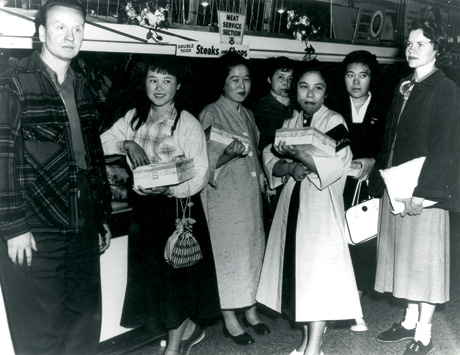
Some of the Hiroshima Maidens with their Quaker Families
During World War II, the Allies were fighting against the Axis Powers. Two countries that were enemies during the war were the United States and Japan. The Japanese were strong willed fighters and refused to give up, so the Allies unfortunately were left to making the decision to drop the atomic bombs on Hiroshima and Nagasaki. The bombs caused mass destruction and thousands were killed and injured on impact or later from the radiation. Many of the Japanese people in the area were injured, lost limbs, and had scars from the atomic bomb droppings. Some of the injuries were so bad that people, like the Hiroshima Maidens, were put into hiding or had trouble with employment because of their condition (Serlin).
Ten years after the war was over, the United States and Japan worked together to help some of the women that were affected by the atomic bomb droppings. A group of 25 Japanese women were selected to travel to the United States to receive surgery and treatment for their scars and became known as the Hiroshima Maidens (Serlin). Once their travel plans were finalized, they made their way to the United States and were placed in Quaker “foster” families. Although Serlin mentions in his article, “Reconstructing the Hiroshima Maidens”, the benefits of living with the Quaker families, he also mentions that they “…constructed normative categories that imputed positive and negative social characteristics to the Japanese women” (95). The Hiroshima Maidens were given a Westernized style of living that they had never experienced before and were also given the opportunity to go to school while in the USA. The women received surgery in order to “fix” their physical appearance caused by the aftermath of the atomic bomb and rehabilitation.
Serlin’s article has a strong argument about bringing the Hiroshima Maidens to the United States for surgery as a publicity stunt and pro-western propaganda. For example, he mentions that the State Department “wished to maintain the belief that the death and mutilation inflicted by the atomic bombs are no different than those caused by conventional weapons…to maintain funding for the nuclear energy research to displace American culpability for the Maidens’ disfigurements as well as to make them seem like ordinary wartime refugees” (67). Was the United States trying to cover up their disastrous bombs by fixing the appearances of a few Japanese women? Were they trying to be sincere and help these poor women who had been mutilated as an effect of the bomb or were they covering their tracks? Serlin later mentions in his article that “…the push to export the American standard of living created opportunities for distributing American consumer goods and cultural products to a worldwide audience” (80). This helps his argument that US was using the Hiroshima Maidens to get on Japan’s good side and push more of their westernized ideas onto them. The “Maidens became poster children for a new kind of postwar identity” (101) and helped push for more advances and uses of plastic surgery after the war.
Martha Gaie also looks at the story of the Hiroshima Maidens in her article, “Healing the Hiroshima Maidens: A Historic Lesson in International Cooperation”. Gaie argues that the Hiroshima Maidens helped international relations between Japan and the United States and that their surgery was very optimistic and supported by the public. For example she mentions “the Maiden ‘miracle” and “remarkable show of public support” (352) to emphasize her argument. She also brings up “the extraordinary cooperation that brought former enemies together for this humanitarian project” (353). This helps to show that Japan and the United States were willing to work with one another even after the war in order to further repair their relationship. The US even sent surgeons over to Japan to help train their surgeons in order to share plastic surgery techniques (353). Gaie has a very optimistic tone about the Hiroshima Maidens and their recovery thanks to the joint efforts between the US and Japan. Unlike Serlin, Gaie is arguing that the US helped the Maidens out of the kindness of their hearts and not as a publicity stunt to make themselves look better after the atomic bomb or to push their westernized ideas onto the Japanese.
Serlin and Gaie have two differing views on how the Hiroshima Maiden situation played out. They both looked at the positives of how the surgery benefited the women, but Serlin goes more in depth on how the US was able to push their western ideas onto the Japanese after the war. Serlin’s argument is also stronger because of the multiple sources he used to back up his claim, brings in different forms of propaganda used during the time, and he goes more in depth about the Maiden’s story. Although Serlin had the stronger argument his paper, Gaie had a better structure for her paper in my opinion. Gaie’s article gave a chronological timeline of the Maiden’s journey to recovery while Serlin jumped around from the rebuilding of Japanese cities to the Maiden’s recovery to other events that were going on.
Serlin’s and Gaie’s articles changed my view of how rehabilitation occurred after the war. I originally thought that rehabilitation was just looked at in terms of the US military and how our soldiers recovered from the war, like prosthesis and therapy. I never considered how we helped other countries rehabilitate and how important of a role plastic surgery started to play in helping soldiers and civilians recover from the war. After learning about how rehabilitation was conducted after WWII, I’m curious to see if the US has helped out other countries that they were at war with after WWII and in other future wars? Did they help out again as a publicity stunt or because they felt guilty or did they just want to help out? Have we pressed our western ideals into other countries that we’ve helped rehabilitate? Also how involved do we want our country to be involved in helping other countries with rehabilitating after a war? Is it our duty as a national power to help countries with rehabilitation after wars?
Sources:
Gaie, Martha. “Healing the Hiroshima Maidens: A Historic Lesson in International Cooperation.” JAMA 276, no. 5 (1996): 351-353.


I want to answer your question of “Is it our duty as a national power to help countries with rehabilitation after wars?” Morally, I think it is absolutely necessary to help other countries rebuild after war. It is confusing to me how a country like the United States could destroy a country, and then turn around and help them ‘rise from the ashes.’ To answer another one of your questions, it does seem that the reason the United States helped rehabilitate Japan was because of the realization guilt after seeing how horrible the atomic bomb was. I really like how you talk about organization. I also felt that Serlin’s article was all over the place and lacked structure.