DISCLAMER: The picture attached to the bottom could be seen as inappropriate and disturbing, if you do not wish to view it do not scroll passed the third paragraph.
World War Two had its fair share of human rights violations and atrocities carried out on all sides in the name of their nations. Many pale in comparison to the actions that took place in the then Chinese capital of Nanking (Nanjing). Or do they? Did the horrific actions said to have taken place actually happen as history suggests? That depends who you are. If you are Tanaka Masaaki then the whole ordeal is blown out of proportion and is a completely false narrative written by China to demonize Japan during the war as said in her book What Really Happened in Nanking – a Refutation of a Common Myth. If you are Iris Chang then you are on the side of history and that the Rape of Nanking was comparable to the Nazi Holocaust against the Jews. Personally I fail to see how anyone can believe that the said incident did not happen, considering the massive amount of evidence both in the forms of survivors, pictures and even journalists who witnessed the event. Iris Chang writes that because the Rape of Nanking is not being taught in Japan, “Japanese culture will not move forward until it too admits not only to the world but to itself how improper were its actions of just half a century ago,” (pg. 14). She goes into examples of Jim Crow in the U.S. South and the Holocaust in Germany that because these events were not allowed to be forgotten the areas in which they happened are better places now because they have learned of their mistakes.
Tanaka Masaaki writes that the Chinese are simply making the event up in order to punish Japan for it’s involvement in the war and their actions against the Chinese. She writes of the commanding general of the Japanese army that took the city, General Matsui Iwane. The army’s ordered were to take the city and stay away from areas of cultural importance out of respect that Iwane had for the Chinese people. Whether any of that is true is up for speculation as there is no evidence that this actually happened and a fair amount of evidence pointing to the massacre. Masaaki writes in direct opposition to Chang’s book, saying that the pictures presented are all entirely fake and created to trick the world into believing the side of the Chinese.
Whether it really happened or not, some 250,000 people do not mysteriously disappear from history, nor do so many sources all relay the same story backed by evidence. Still, it is a historians duty t attempt to bring the truth to fruition, and there is evidence to both sides. One cannot deny that the Chinese people could be faking the event, as they would have all the reason to after the war ended.
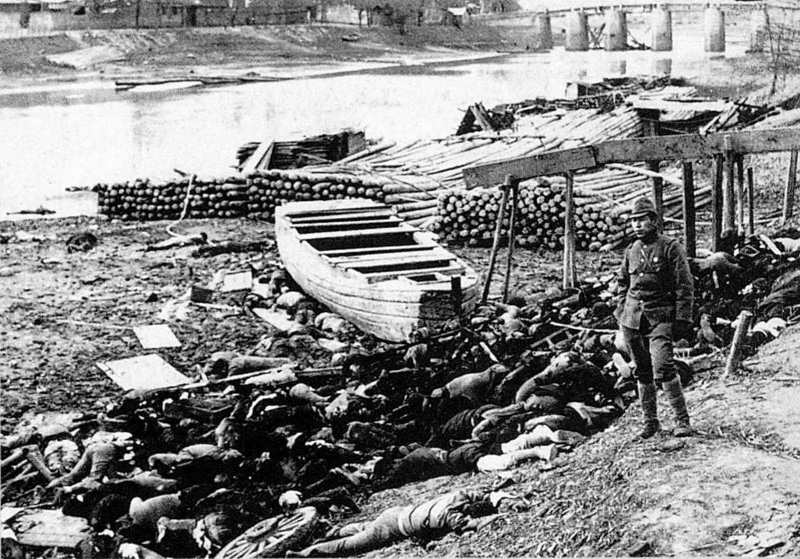
Bodies of victims along Qinhuai River out of Nanjing’s west gate during Nanjing Massacre.


I found Tanaka Masaaki’s refutations fascinating. It brought a lot of questions to my mind regarding his motives. I have been wondering what Masaaki’s motivations are. Is he deliberately trying to rewrite the narrative in order to preserve Japanese pride? Was he fed a narrative by the Japanese government and was simply trying to protect his perception of reality? The latter is what happened, only in some instances, in the American South. People were fed the Lost Cause narrative in such a way that they accepted it as reality. They actively tried to maintain this understanding of reality, whether or not they had been exposed to the truth.
The excerpts from Masaaki I found to be extremely disturbing. He completely believes that the massacres at Nanking never happened. His writing so strongly denies it that I originally thought it was fake. It also made me question if these were his own thoughts or if he was writing propaganda for the Japanese government. I concluded that these are his own beliefs but it is disturbing that Japan has swept the atrocities it committed during WWII.
Masaaki I believe has clearly been guided by his country of Japan to believe the massacre didn’t happen. He had never been taught that this was a thing that happened, in fact he seemingly has been convinced of the opposite. I think his motives are interesting to hypothesize about, as we can never truly know, but I think he likely is defending his viewpoint to maintain his own sense of reality. Learning that your people committed and covered up such an act would be pretty devastating for most people, and he doesn’t want to have to believe it if at all possible.
While it is disturbing that a person could be in denial about an event such as this, it is interesting to view the way in which Tanaka Masaaki expresses his opinion. His writing style alone leads to some interesting conclusions, but when put in the context of other readings and documentaries, he seems to be sort of crazy in his explanation.
I was intrigued by Masaaki’s argument. He did travel to Nanking after the war and claims to have looked into every nook and cranny and still found no evidence of the Rape of Nanking. But, this was a while after the event. What I want to know is does Masaaki truly believe that the rape did not happen or is he just trying to convince himself and other through his writing.
I think you bring up an important point about how history is recorded and presented, evidence on both sides could be seen as compelling but its hard to dispute Chang and the missing 250k+ missing people. It also made me wonder what stakes are in it for Masaaki?
I think the comparison to slavery and Jim Crow era US is an interesting one. While this part of history is well recorded and most Americans acknowledge it, there are still many who choose to deny the realities of slavery and racial prejudice in the US. Particularly, the post Civil War “lost causers” remind me of the way that Japan has denied the events at Nanjing (i.e. omitting from textbooks, war memorials, etc.).
While it is important to consider all of the perspectives when analyzing an event that has taken place historically, I believe that being blinded by biases is very dangerous. Listening to the argument that Masaaki makes is important, but it is more important to be able to analyze his argument and come to terms with the fact that he is blinded his nationalism for Japan, and ultimately wrong.